Earlier today, someone told me, “You’re not you when you’re hungry. Eat a Snickers bar.”
Why am I not me when I’m hungry? Did I skip breakfast? No, I flipped on the stove top for the first time in weeks and fried up some bacon, placing it calmly on a bed of cheesy scrambled eggs when it was all said and cooked. It’s past lunchtime, though, so maybe I am just a bit famished.
But why is my hunger coinciding with a feeling of… anger? Why am I suddenly so peeved? Life has been good; the Panthers just won the Stanley Cup, my debt’s been cleared, and I’m enjoying my day job.
I carry on with my day when I think about it for a second… why does it have to be a Snickers bar that relieves my hunger? I’m realizing now that I’m, indeed, quite upset. The lack of reasoning behind what makes Snickers a prime candidate in this situation is starting to irritate me more than my empty belly. I decided to cave in and eat a chocolate bar for lunch.
I walked over to my local 7-Eleven and began rummaging through the shelves for a nutritious king-sized Snickers bar, which I knew was likely buried somewhere in the back, near the energy drinks and Slim Jims. I made the purchase, and after taking my first bite of bliss, my hunger and anger had simultaneously mellowed. It was magic in the form of a chocolate bar.
In reality, the phrase “You’re not you when you’re hungry” is from a Snickers advertising campaign, one that is universally recognized as one of the best campaigns of the 2010s. However, before we discuss it, let’s take a brief look at the history of the chocolate bar.
Chocolate Covered History (With a Side of Peanuts) 🍫🥜
Snickers was first created in 1930 by Mars Inc., a business founded by the Mars family. The chocolate bar was named after the Mars family’s favorite horse.
Not much is known about the Mars family history. They were intentionally very private with their affairs and tended to keep most of their business behind closed doors. What you need to know is this: Snickers, Milky Ways, 3 Musketeers, Mars bars. None of these chocolate bars would exist if it hadn’t been for the Mars family.
The limited information available suggests that the company’s founder is Franklin Clarence Mars. In 1911, at the age of 28, he founded the Mars Candy Factory alongside his second wife, Ethel V. Mars. The two set up shop in Tacoma, Washington, but failed to profit due to nearby competition from Brown & Haley (Almond Roca).
After returning to the drawing board, Mars and his wife moved to Minneapolis, Minnesota, where they began a manufacturing facility specializing in chocolate bars. The company was called Mar-O-Bar Co. and later incorporated as Mars, Incorporated.
What’s interesting is that the company’s first breakthrough came from Franklin’s son, Forrest, who presented his father with the idea for Milky Way. In 1923, the company began manufacturing Milky Way, which quickly became its best-selling candy bar.
As the business continued to thrive, the company sought to introduce a chocolate bar featuring peanuts. What they settled on was Snickers, a bar consisting of peanuts paired with nougat and caramel, and a chocolate shell. It was developed and released in 1930, a full two years before the Mars bar had been unveiled.
Around this time, Franklin moved to Chicago, where he’d live for five years as an honorary captain of the Oak Park, Illinois, police department. Following his death in 1934 from heart and kidney issues, ownership of the business was passed down to Forrest.
It’s safe to say that Snickers, along with Mars Inc., has become reasonably successful since its creation nearly 100 years ago. To date, it is the best-selling chocolate bar of all time, with sales of a remarkable 400 million bars annually.
Let’s now focus on the beginning of the 2010s, a time when Snickers, a game-changing chocolate bar, revolutionized the advertising landscape.
You’re not you when you’re hungry, you’re… Betty White? 👩🦳
Between 2007 and 2009, Snickers faced a drought. Although they retained their position as the world’s leading chocolate bar, they were falling behind their fellow global chocolate brands. They began losing market share, and if they didn’t act quickly, they would lose their position at the top.
With their backs against the wall, Snickers had to do something. In retaliation, they released one of the most memorable marketing campaigns of the 2010s.
Launched during a Super Bowl commercial break in 2010, Snickers’ first commercial, and the initial introduction of their “You’re not you when you’re hungry” campaign, featured a memorable cameo from the late Betty White.
The commercial depicts White playing football alongside a group of fellow amateur football players. If it sounds too outrageous to be true, that’s because it is.
While the viewer is left puzzled, White embodies a football player having a terrible game and is not playing up to the standards he has set for himself and his teammates.
The team runs a play, and White (embodying the man) gets walloped by a defensive player, falling into a puddle of mud. Dazed and confused, she returns to the huddle.
“Mike, what is your deal, man?” says a teammate. At this point, the illusion is starting to break. Mike? That’s not Mike. That’s very obviously Betty White. What’s the meaning of this?
Another teammate chimes in, “Mike, you’re playing like Betty White out there.”
White then snaps back, “That’s not what your girlfriend says.” Even without the script, this is a phrase Betty White’s probably said before.
Then, a girl hidden in the blurry background runs from the bleachers onto the field, handing White what looks to be a Snickers bar.
White then takes a bite, and the camera cuts away to the girlfriend.
“Better?” she says. “Better,” says Mike, who has come to his senses and is no longer Betty White.
The ending of the advertisement features the phrase “You’re not you when you’re hungry.”
Humor Attracts 🤣
With that one commercial, Snickers solidified itself as the worldwide cure for a hangry attitude. It was a commercial like no one had seen before, a concept that harbors a stark contrast to what you’d see in a Nike commercial, where the brand leans on emotion and motivation.
If Nike takes themselves seriously, Snickers made itself the class clown with this latest commercial outing. This was intentional — the company knew that it didn’t have to take itself seriously; it’s marketing a chocolate bar, after all.
What followed was a multitude of other ridiculous commercials, including one that featured the incomparable Mr. Bean, otherwise known as Rowan Atkinson, embodying a Kung Fu master. At some point, following a comedy of errors, Atkinson eats a Snickers bar. This brings the Kung Fu master back to life and helps him evade trouble. The caption of the video reads, “Mr. Bean demonstrates that you’re not Kung Fu when you’re hungry.”
This marketing effort from Snickers was authentic, and it wasn’t just shown through commercials. Check out this image courtesy of Snickers’ social media marketing team.
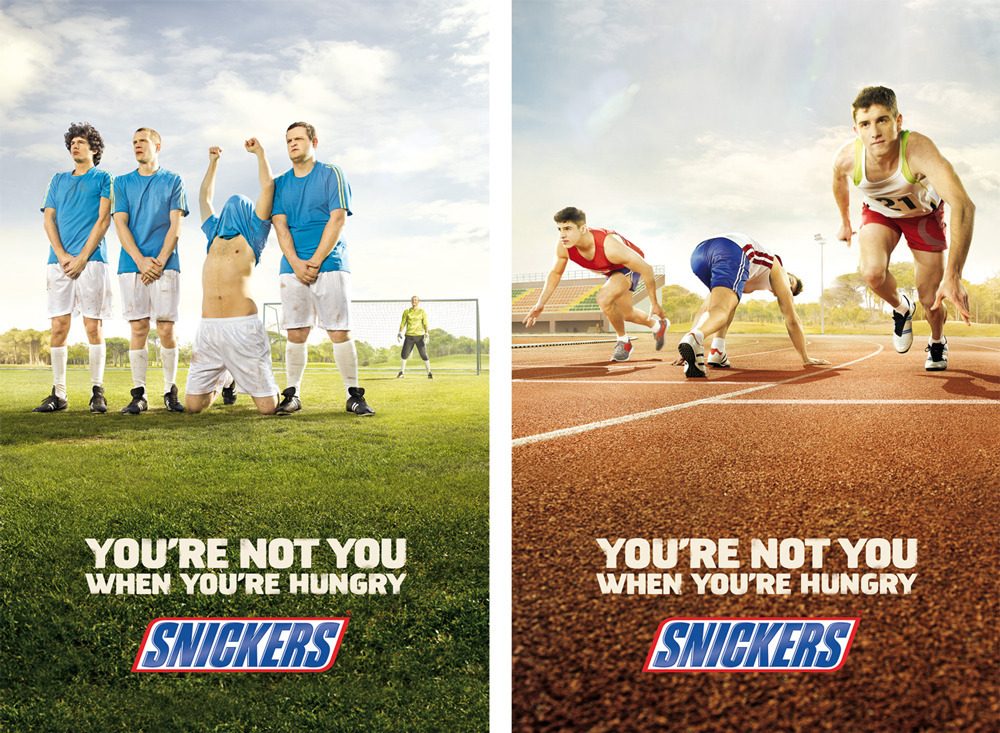
It’s outrageous, it’s different, and most importantly, it got people talking. It had audiences around the globe asking, “Have you seen the latest Snickers advertisement? It’s ridiculous!” Soon, Snickers managed to turn a simple campaign into a cultural phenomenon, one that remains the cornerstone of the chocolate bar 15 years later.
What small businesses can take away from companies like Snickers is that it’s okay, especially in this day and age, to incorporate humor into their advertisements, particularly when marketing to a younger generation. Humor is something that is very easily marketable, and if you find your rhythm, then you might strike gold with your audience.
Snickers is also a picture-perfect example of how a single idea can transform into a long-term marketing strategy. Take Geico’s Australian gecko, for instance. Did you know that Geico’s little green mascot has been telling drivers to save 15% or more on car insurance for the last 23 years? Longevity pays off, especially when you have a strategy that creates a strong bond between you and your audience.
Let’s wrap this up with some numbers:
- In 2010, following its first commercial feature with Betty White, Snickers saw a 15.9% increase in global sales.
- Snickers saw a $376 million sales increase in its first two years following the introduction of the campaign.
- Research from Oracle indicates that 90% of consumers are more likely to remember a brand that incorporates humor into its advertising.
- The same research also shows that 80% of consumers are more likely to buy from a brand they perceive as humorous.
Bottom line — when in doubt, make it funny. People love to laugh. Comedy can bring people together and truly help differentiate your brand from most others.